Ekadashi Comparison: Luna 1 · ARTEMIS P1 · ARTEMIS P2
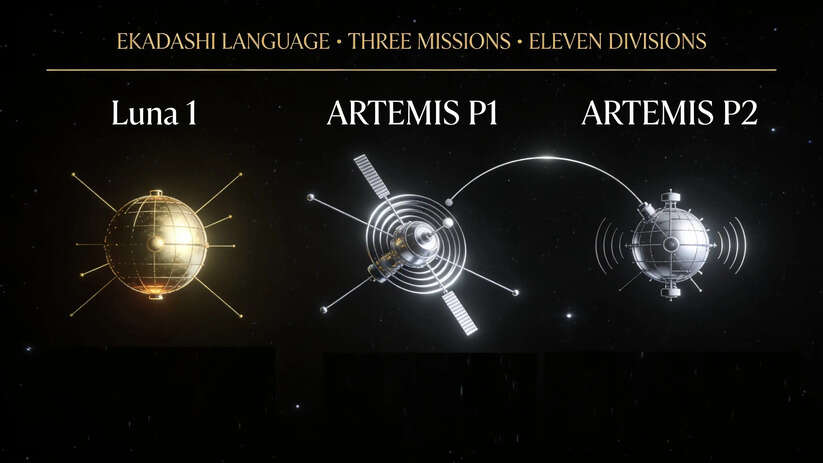
Ekadashi Comparison: Luna 1 · ARTEMIS P1 · ARTEMIS P2
The three missions span 52 years of space history (1959–2011) and three distinct civilizational moments. Luna 1 was a first-generation ballistic probe; ARTEMIS P1 and P2 were repurposed heliophysics spacecraft whose second lives exceeded their first. The Ekadashi grammar holds stable across all three - which is precisely the grammar's claim.
Ekadashi Division Comparison
| Division |
Luna 1 (1959) |
ARTEMIS P1 (2007–present) |
ARTEMIS P2 (2007–present) |
| 1 - Object |
Declared: lunar impact. Achieved: solar orbit. Object transformed mid-mission by error into a historic first |
Declared: Earth substorms. Achieved: lunar plasma environment. Object formally renegotiated through extended mission approval |
Declared: Earth substorms. Achieved: 3D lunar wake via coordinated twin measurement. Object relational - inseparable from P1 |
| 2 - Channel |
Multi-channel: radio telemetry, charged particle sensors, magnetic field, optical (sodium comet). First multi-channel interplanetary array |
Five electromagnetic and particle channels designed for Earth, proven channel-agnostic at the Moon |
Identical five channels as P1, but epistemic value jointly constituted - a 10-instrument distributed channel network |
| 3 - Payload |
Six instruments: magnetometer, micrometeorite sensors, ion traps, Geiger counters, scintillation counter, Cherenkov detector; plus 1 kg sodium canister. Purpose-built for lunar encounter |
FGM, SCM, EFI, ESA, SST - inherited Earth-magnetosphere suite repurposed for lunar plasma science |
Identical instruments; payload transcends hardware - its scientific power is relational, producing 3D knowledge only in stereo with P1 |
| 4 - Platform |
No propulsion; passive ballistic sphere; battery-only power; 62-hour operational window. Minimal platform designed for single brief encounter |
Spinning small-sat; monopropellant blowdown; ~37W power; 12Ah battery. Built for 2.5 years, operated 15+. Fuel poverty converted into trajectory genius via WSB transfer |
Identical platform; more fuel than P1 at repurposing - paradoxically requiring a more direct, less elegant trajectory. Sequenced after P1 to reduce operational risk |
| 5 - Electronics Layer |
Vacuum tube and early transistor era. Critical engine-cutoff command transmitted from ground, not onboard - the distributed electronics gap that caused the Moon miss |
Analog/digital low-power architecture; autonomous fault protection critical during 18-month WSB transfer. Electronics operated years beyond heritage qualification |
Identical electronics, but operated with P1-calibrated parameters - fault protection logic refined by P1's prior transfer telemetry before P2 entered same regime |
| 6 - Fidelity |
Scientific fidelity high (solar wind measured, null magnetic result precise). Political/credibility fidelity contested - US Congressional hearings required to validate mission reality. Sodium comet = independent visual verification channel |
Fidelity strained: calibrating Earth instruments for lunar environment, separating spacecraft noise from ambient fields, cross-validating against Wind/ACE upstream monitors |
Fidelity co-constituted: P2's mini-magnetosphere observation required P1's simultaneous upstream reference to distinguish spatial structure from temporal fluctuation |
| 7 - Frontier |
Triple simultaneous frontier: gravitational escape, interplanetary navigation, direct solar wind measurement - all crossed in a 62-hour window |
Triple frontier: first libration-point stationkeeping, first single-point lunar plasma measurements, demonstration of extended mission lifecycle economics |
Triple frontier: first lunar mini-magnetosphere direct detection, first subsonic wake measurement in geomagnetotail, first real-world cislunar navigation data for future Gateway/Artemis |
| 8 - Data and Evidence |
Solar wind ion density, outer Van Allen particle data, magnetic null at Moon; credibility established through Congressional testimony and sodium comet photography |
Wake structure, crustal field maps, reconnection signatures at lunar distances; validated against Wind/ACE with 2650-second time-shift methodology |
3D wake characterization, subsonic sunward wake in magnetotail, mini-magnetosphere evidence; evidence requires both probes - solo P2 data would be ambiguous |
| 9 - Human Interface |
Served Soviet state, mission controllers, mountain astronomers, Cold War legislators, global public. Mission renamed Mechta (Dream) - human aspiration embedded in spacecraft identity |
Served heliophysics community at Berkeley/UCLA, future crewed Artemis planners (radiation environment mapping), and the mission economics philosophy of extended spacecraft reuse |
Served same science community; uniquely serves future Artemis crewed surface operations through mini-magnetosphere radiation shielding data at candidate landing sites |
| 10 - Validation |
Engine-cutoff by radio command (no onboard automation - human judgment deemed more reliable). Sodium comet as independent trajectory verification. Validation failure in command timing produced the Moon miss |
Validated by Monte Carlo trajectory analysis; instrument requalification assessed for extended operations; fuel budget validated maneuver-by-maneuver. Validation governed by P1-specific eclipse constraint |
P1's operational experience became P2's validation inheritance. LOI burn chain validated residual propulsion health. Validation was sequenced and cumulative |
| 11 - Foundry |
Downstream of Soviet war-and-nuclear fabrication civilization: rocket engineering from V-2 heritage, nuclear-program electronics, Academy of Sciences instrument-making. No space industry existed - a general civilization extended beyond atmosphere |
Downstream of early 2000s American small-satellite scientific fabrication culture. Key insight: fabrication margin - conservatism built in for Earth orbit - became the enabling substrate of a historic lunar mission |
Identical foundry origin; unique foundry insight: lunar gravity as propellant substitute - celestial mechanics offloaded propellant demand, extending fabrication budget by replacing chemical energy with orbital geometry |
The Three Civilizational Profiles
Reading across all eleven divisions, each mission reveals a distinct civilizational profile under Ekadashi grammar:
Luna 1 is the profile of first crossing - a system whose every dimension was stretched to its absolute limit, whose Object transformed under pressure, whose Validation failed in the most consequential possible way, and whose Foundry was not a space civilization but a war civilization reaching beyond itself. Its Frontier was not one edge but the boundary between Earth-bound and solar existence. Its deepest Ekadashi character is rupture: it did not refine a prior capability; it ruptured the prior limit entirely.
ARTEMIS P1 is the profile of constraint genius - a system that succeeded most profoundly where its original specifications were silent, that converted fuel poverty into trajectory elegance, that aimed Earth instruments at the Moon and produced lunar science of lasting value, and that demonstrated the deepest Foundry truth: fabrication margin, designed for safety, becomes the substrate of discovery. Its deepest Ekadashi character is transformation: every constraint became a gateway.
ARTEMIS P2 is the profile of relational completion - a system whose Object, Channel, Fidelity, Evidence, and Frontier achievements are all jointly constituted with P1. It is the rare space system that cannot be fully read as a singular organism: its Ekadashi grammar requires a dyadic reading. Its deepest character is stereo: the second voice without which the first remains a monologue, and the spacecraft whose foundry insight revealed that celestial mechanics can substitute for chemical propellant.
What the Comparison Yields
The comparison demonstrates the most important structural claim of Ekadashi Language: the same grammar holds across 52 years, three nations' industrial cultures, two mission generations, and three fundamentally different system architectures - a 1959 ballistic Soviet sphere, a 2007 American small-sat repurposed into a libration-point pioneer, and its twin repurposed into a dyadic science system. Ekadashi's grammar is stable precisely because it is not tied to any technology generation - it is tied to the irreducible dimensions of what any space system must be.

- https://dotsias.com/current-affairs-quiz/
- https://pujayagna.com/blogs/hindu-fasting-days/ekadashi-fast
- https://downloads.cs.stanford.edu/nlp/data/jiwei/data/vocab_wiki.txt
- https://dotsias.com/blog/
- https://en.wikipedia.org/wiki/Ekadashi
- https://en.wikipedia.org/wiki/Prabodhini_Ekadashi
- https://spacepolicyonline.com/images/stories/PSDS IP2 Khurana Artemis.pdf
- https://vedanshcraft.com/blogs/news/types-of-ekadashi
- https://vedanshcraft.com/en-us/blogs/news/types-of-ekadashi
- https://www.eprarthana.com/offers/ekadasi/ekadasi.asp