
The 16 Families of Human Exchange: How Value Moves Through the Economy
-
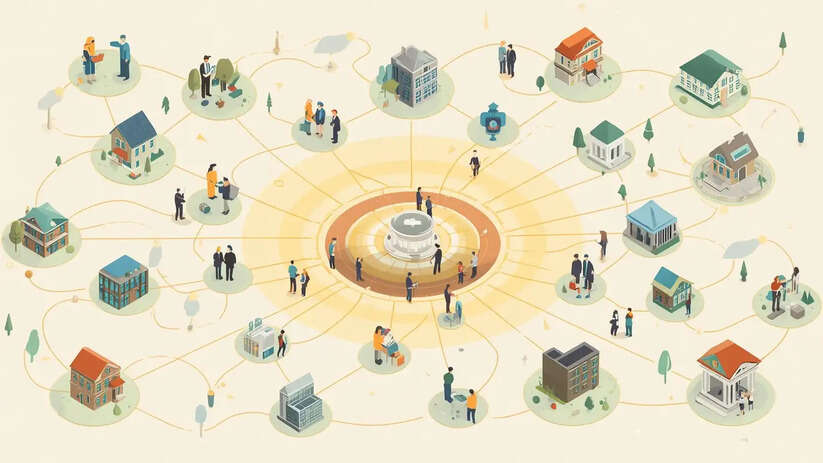
Beyond buying and selling: Human exchange includes employment, construction, professional and technical services, renting, brokerage, finance, ownership and non-monetary transactions.
-
Sixteen distinct exchange families: The framework organises major ways in which people, enterprises and institutions provide services, transfer assets, undertake obligations and receive economic benefits.
-
One enterprise, many exchanges: A single business may employ workers, rent property, borrow capital, purchase goods, engage specialists and sell products, each through a different economic relationship.
-
Money received is not always income: Loans, share investments, dividends, property sales and ordinary business revenue have different economic and legal meanings.
-
Digital platforms create overlapping relationships: An online purchase may simultaneously involve a sale of goods, marketplace facilitation, payment services and brokerage, without creating multiple underlying sales.
-
A common grammar for economic life: Shared Space explains where activity happens, the sixteen exchange families explain how value moves, and the Twenty-Four Laws help explain the legal relationships governing it.
THE SIXTEEN FAMILIES OF HUMAN EXCHANGE
A Note on the Movement of Goods, Services, Money, Rights and Economic Value
Abstract
Every day, millions of exchanges take place among individuals, households, enterprises, governments and other institutions. A worker receives a salary, a shopkeeper sells goods, a bank advances a loan, a company issues shares, a landlord receives rent, and a software developer licences technology to a customer. These activities appear different, but they share one broad characteristic: something of economic or legal significance moves between participants, or a commitment is created concerning such movement.
This note proposes a simple framework of sixteen exchange families for understanding these activities. Each family represents a recognisable kind of economic relationship, such as employment, construction, professional services, leasing, sale of goods, lending, equity ownership or barter. The purpose is to make the world of exchange easier to understand without treating every transaction as merely a sale or purchase.
The word exchange is used in a broad analytical sense. Most families involve reciprocal transactions, but some include payments, distributions or contingent receipts that are not exchanges in the strict contractual sense. Dividends, for example, arise from an ownership relationship, while prizes may depend upon specified events rather than a conventional exchange of goods or services.
The sixteen families are therefore a practical classification of economically significant transactions and receipts. They can help explain how people earn income, how enterprises obtain resources, how capital circulates and how rights move from one participant to another.
PART I - UNDERSTANDING EXCHANGE
1. What is an exchange?
An exchange occurs when one participant provides, transfers or promises something of value to another participant under an arrangement that may involve a corresponding payment, benefit, undertaking or other consideration.
The simplest exchange is the purchase of an ordinary product. A customer pays money to a shopkeeper, and the shopkeeper transfers the product to the customer. The customer receives the product, while the shopkeeper receives money.
However, many exchanges are more complicated. A person may provide work today and receive wages next month. A bank may provide money now and expect repayment with interest over several years. A landowner may permit another person to use property while retaining ownership.
The common question is:
Who gives what, to whom, under what arrangement, and what does each participant receive or become entitled to receive?
2. Exchange is different from operation and interaction
An operation is something a person or institution does. A farmer cultivating a field, a scientist conducting an experiment and an officer examining a government file are all performing operations. These operations do not necessarily involve exchange.
An interaction arises when two or more participants affect or engage with one another. They may negotiate, cooperate, compete, disagree or exercise authority. Again, an interaction does not necessarily involve exchange.
An exchange is a more specific relationship involving the movement or reciprocal provision of goods, services, money, rights or other economic interests. Every exchange generally involves some relationship between participants, but not every interaction is an exchange.
3. Seven questions that explain an exchange
Most exchanges can be understood by asking seven straightforward questions.
- Who are the participants? Individuals, firms, companies, governments or other institutions.
- What is being provided? Labour, goods, services, money, property, rights or another benefit.
- What is being received? Payment, ownership, repayment rights, continued services or another benefit.
- Why does the exchange occur? Employment, sale, borrowing, investment, licensing or another purpose.
- When does it occur? Immediately, periodically, over a contract period or upon a future event.
- What legal relationship governs it? Employment, sale, lease, loan, agency, corporate ownership or another arrangement.
- What remains afterward? Income, ownership, debt, an obligation, a continuing right, a risk or another consequence.
These questions form the common language of the sixteen exchange families.
PART II - THE SIXTEEN EXCHANGE FAMILIES
Family 1 - Labour and Employment Exchange
The exchange of human effort for remuneration.
Labour exchange begins when a person agrees to work for another person or organisation within an employment relationship. The employee provides time, effort, skill and services, while the employer undertakes to provide salary, wages or other agreed remuneration. Depending on the relationship and applicable law, the employer may also have obligations concerning working conditions, social security, leave and other benefits.
Consider a school employing a teacher. The teacher provides teaching services, while the school pays a salary. The school benefits from the teacher's work, and the teacher receives remuneration and the rights associated with employment.
The important distinction is that employment is not simply the purchase of an isolated result. It normally involves a continuing relationship with legally relevant responsibilities, organisational arrangements and varying degrees of supervision. An independent consultant may perform similar work but belong to another exchange family because the underlying legal relationship is different.
Typical examples: Factory employment, government service, office employment, teaching, healthcare employment and salaried technical work.
Family 2 - Works and Construction Exchange
The exchange of completed work or project execution for payment.
This family concerns arrangements in which one participant undertakes to construct, install, fabricate, repair, maintain or execute a specified work. The customer may be interested principally in the completed result, although the agreement may also regulate materials, labour, milestones, quality and methods of execution. Payment may be linked to progress, completion, quantities or other agreed terms.
Consider a company engaging a contractor to construct a warehouse. The contractor organises workers, equipment and materials, while the company pays according to the agreement. The main object of the exchange is the execution of the construction work.
This family is different from employment because the contractor may independently organise the work and assume contractual responsibility for the agreed result. It can also overlap with the sale of goods when materials are supplied as part of the works. The legal and tax treatment of such an arrangement depends upon its actual terms and applicable legislation.
Typical examples: Building construction, road works, installation projects, fabrication, repairs and industrial maintenance.
Family 3 - Professional Services Exchange
The exchange of professional knowledge, judgement and assistance for fees.
Professional services involve the application of specialised education, experience, skill or judgement for the benefit of another participant. The customer generally pays for advice, representation, diagnosis, design, analysis or another professional service. The professional's obligations may involve care, competence, confidentiality, professional standards and applicable regulatory requirements.
Consider a business engaging an architect to design an office building. The architect studies the requirements, prepares the design and provides professional advice. The business pays a fee for the professional service.
Professional work does not always guarantee a particular commercial outcome. A lawyer's fee does not automatically guarantee success in litigation, and a doctor's fee does not guarantee recovery from illness. The professional relationship must therefore be distinguished from an ordinary agreement to deliver a standard product.
Typical examples: Legal services, accounting, architecture, medical practice, financial advice and other professional consultancy.
Family 4 - Technical Services Exchange
The exchange of technical capability, engineering skill and specialised technological assistance.
Technical services concern work requiring specific technological or engineering capability. The provider may design a system, develop software, test a product, integrate equipment, analyse technical data or solve a specialised technical problem. The customer pays for the technical service under the agreed arrangement.
Consider an electronics company engaging an engineering team to design a circuit board. The engineering team prepares the design files, calculations and technical documentation. The company pays for the technical work and receives the agreed deliverables and rights.
Technical services may overlap with professional services, works contracts and intellectual property licensing. The distinction is useful because a technical design, a manufacturing service and a licence to use a patented invention are not necessarily the same legal or economic transaction. The precise rights transferred must therefore be identified rather than inferred from the word technical.
Typical examples: Engineering design, software development, product testing, technical consulting, system integration and research support.
Family 5 - Rent and Lease Exchange
The exchange of temporary use or enjoyment of an asset for rent or other consideration.
Rent and leasing arrangements arise when a person permits another to use or enjoy property or an asset for a specified period or upon specified terms. Ownership may remain with the original owner, while the user obtains the rights granted under the agreement and applicable law. Payments may be periodic or structured differently.
Consider a company renting an office building for five years. The property owner continues to own the building, while the company receives the agreed rights to occupy and use it. Rent is paid according to the arrangement.
The critical distinction is between using an asset and acquiring ownership of it. Renting an apartment is not the same as purchasing the apartment, even if both involve payments to the same owner. Different statutory rules may apply to leases of immovable property, equipment rentals, licences and other arrangements.
Typical examples: Residential rent, commercial leases, machinery rental, equipment leasing and warehouse occupation.
Family 6 - Commission and Brokerage Exchange
The exchange of intermediation or transaction-facilitation services for commission or brokerage.
In this family, one participant helps another find customers, suppliers, buyers, sellers or suitable transactions. The intermediary may introduce parties, negotiate terms, facilitate a transaction or perform specified services on behalf of a principal. Payment is often calculated as a percentage of transaction value, although a fixed fee is also possible.
Consider a property broker helping a person find a buyer for a house. The seller owns the property and the buyer purchases it, while the broker receives remuneration for the services performed. The broker does not necessarily become the owner of the property being sold.
This distinction is fundamental. A broker's income arises from the intermediation service, not automatically from the total value of the underlying property or goods. Agency, brokerage, distributorship and independent sales arrangements may also involve different legal relationships.
Typical examples: Real estate brokerage, commodity brokerage, sales commissions, recruitment intermediation and commercial agency.
Family 7 - Insurance Intermediation Exchange
The exchange of insurance distribution or intermediation services for remuneration.
Insurance intermediation is a specialised family because insurance transactions involve risk protection, policyholders, insurers and regulated distribution relationships. An intermediary may help customers identify insurance products, arrange cover or perform other permitted functions. Remuneration may take the form of commission or other legally permitted payments.
Consider an insurance agent assisting a customer in obtaining a life insurance policy. The customer enters into the relevant insurance arrangement with the insurer, while the agent performs permitted distribution functions. The agent's compensation is distinct from the insurance premium and from the insurer's obligation under the policy.
Insurance intermediation belongs near general brokerage, but its separate classification preserves its specialised regulatory and risk-related character. The underlying insurance contract is itself another legally important relationship in which the insurer undertakes specified obligations in return for the premium. It must not be confused with the agent's intermediation service.
Typical examples: Insurance agents, insurance brokers, certain insurance distribution services and regulated policy-placement arrangements.
Family 8 - Immovable-Property Transfer Exchange
The exchange involving the transfer of legally recognised interests in land or immovable property.
This family concerns transactions involving the transfer of ownership or other relevant interests in immovable property. The property may include land, buildings or legally recognised rights associated with them. Transfers must satisfy the applicable legal requirements, which may include documentation, registration, permissions and other conditions.
Consider a family purchasing a residential apartment. The buyer pays the agreed price, while the seller transfers the property interest under the required legal arrangements. The transaction may also involve lenders, agents, government registries and tax obligations.
Property transfer is different from property use. A purchase changes the relevant ownership position, while a rental arrangement ordinarily grants specified rights of use without the same transfer of ownership. Property value, sale consideration and taxable gains must also be distinguished.
Typical examples: Agricultural land sales, residential property purchases, commercial property transfers and land transactions.
Family 9 - Sale of Goods Exchange
The exchange of goods for money or other agreed consideration.
The sale of goods is one of the most familiar forms of exchange. A seller supplies goods under a transaction, while the buyer undertakes to pay the agreed consideration. Depending upon the terms and applicable law, ownership, possession, risk and payment may transfer at different moments.
Consider a manufacturer selling one hundred electronic instruments to a school. The manufacturer supplies the instruments and the school pays the price. The transaction may also include warranties, transport obligations, installation or after-sales services.
A sale of goods must be distinguished from construction work, technical services, rent and financing. Buying an instrument is different from hiring an engineer to design it, renting it for six months or borrowing money to finance its purchase. Each arrangement may engage different contractual and regulatory obligations.
Typical examples: Food products, vehicles, machinery, clothing, electronic products, raw materials and manufactured goods.
Family 10 - Digital Marketplace Transactions
Exchange conducted or facilitated through a digital marketplace or platform.
Digital marketplaces connect participants using websites, applications, payment systems and other digital infrastructure. The platform may act as an intermediary, seller, service provider or participant in another capacity, depending upon the actual commercial arrangement. The underlying exchange may involve goods, services, digital content or other legally recognised interests.
Consider a customer purchasing a pair of shoes through an online marketplace. The customer pays through the platform, the seller supplies the shoes, and the platform may receive a fee for facilitating the transaction. The underlying purchase remains a sale of goods even though it occurs through digital infrastructure.
This is an especially important distinction in the sixteen-family architecture: digital marketplace classification often describes how an exchange occurs, not a completely separate type of economic object. A single event may therefore belong to both Family 9 and Family 10. The same amount should not be counted twice merely because the transaction has two classification labels.
Typical examples: E-commerce marketplaces, app-based service platforms, online booking systems and digital business marketplaces.
Family 11 - Lending and Interest Exchange
The provision of credit in return for an obligation to repay, often with interest.
Lending occurs when one participant advances money or another legally recognised form of credit to another under an arrangement requiring repayment. The borrower receives financial resources or purchasing capacity, while the lender receives a claim for repayment and any agreed interest or other permitted charges. Repayment may take place immediately, in instalments or at maturity.
Consider a bank advancing a loan to a small manufacturing enterprise. The enterprise uses the loan to purchase equipment and agrees to repay the bank according to the loan terms. Interest compensates the lender under the financing arrangement, subject to applicable legal conditions.
The principal amount of a loan is different from the lender's interest income. Receiving a loan does not ordinarily mean that the borrower has earned the loan principal as income, because a corresponding repayment obligation arises. Similarly, the repayment of principal is not the same as paying interest.
Typical examples: Business loans, housing loans, personal loans, working-capital facilities and inter-corporate lending.
Family 12 - Bonds and Debt Securities Exchange
The raising, holding or transfer of money through marketable debt instruments.
A bond or other debt security normally represents an obligation of its issuer under specified financial terms. Investors provide money when subscribing to a new issue, while the issuer undertakes to make payments according to the instrument. Existing instruments may subsequently be traded among investors.
Consider a company issuing bonds to finance the expansion of a factory. Investors purchase the bonds, and the company becomes obligated to make the agreed payments. An investor may later sell the bond to another investor, producing a secondary-market transaction without necessarily providing new money to the issuing company.
This distinguishes bonds from an ordinary bilateral loan, even though both involve debt. Debt securities may be transferable, widely held and traded through regulated financial markets. Interest, principal repayment, issue proceeds and trading gains should therefore be identified separately.
Typical examples: Corporate bonds, government securities, debentures and other qualifying debt instruments.
Family 13 - Equity and Dividend Exchange
The provision, transfer or holding of ownership capital and the distribution of returns to owners.
Equity represents an ownership interest in an enterprise or another relevant organisation. Investors may acquire new shares by contributing capital to a company or purchase existing shares from another owner. These two transactions have different consequences because a new issue may bring capital into the company, while an ordinary secondary-market purchase transfers an existing ownership interest.
Consider an investor subscribing for shares issued by a company. The company receives the subscription money, and the investor obtains the relevant shareholder rights. If the company later declares and pays a dividend in accordance with law, the investor receives a distribution arising from that ownership relationship.
A dividend is not an ordinary purchase payment for goods or services. Nor is it the same as interest on a loan, since equity ownership and lending create different rights and risk exposures. Dividends, share transfers, capital contributions and gains from selling shares are therefore distinct events within this broad family.
Typical examples: Equity subscriptions, share purchases, venture capital investment, shareholding and dividend distributions.
Family 14 - Gaming, Prizes and Contingent Winnings
The receipt or allocation of money or benefits depending upon specified uncertain events, contests or prize arrangements.
Some economic receipts arise from circumstances in which a participant's entitlement depends on an uncertain event, a contest result, a prize scheme or another defined contingency. The receipt may be connected with participation, skill, chance or a combination of factors. The applicable law determines whether the arrangement is permitted, restricted or prohibited.
Consider a person entering a lawful prize competition and receiving an award after meeting its conditions. The participant may have paid an entry fee or may have entered without payment. The prize receipt is not necessarily compensation for employment, a professional fee or consideration for goods.
This family requires careful treatment because not all prizes are gaming winnings, and not all gaming arrangements are legally permitted. Scholarships, merit awards, promotional prizes and prohibited wagering transactions may have very different legal characteristics. Family 14 is therefore a broad descriptive category, not an assumption that every contingent receipt is a lawful bilateral exchange.
Typical examples: Lawful contest prizes, lotteries where legally authorised, specified gaming winnings and other qualifying contingent receipts.
Family 15 - Virtual Digital Asset Exchange
The transfer, acquisition or exchange of assets falling within an applicable legal definition of virtual digital assets.
Virtual digital assets are a distinct class of digitally represented value or rights recognised under particular statutory definitions. Transactions may involve their acquisition, sale, transfer or exchange for money or another asset. Their legal and fiscal treatment depends upon the asset, transaction and applicable legislation.
Consider one participant transferring a qualifying virtual digital asset to another in exchange for an agreed amount of money. One participant obtains the asset, while the other receives payment. Digital records may document the transaction, but those records alone do not settle every question of ownership, legal validity or regulatory compliance.
A virtual digital asset transaction is different from buying an ordinary digital service, subscribing to software or purchasing a physical product through an online marketplace. The mere use of computers, cryptography or electronic payment does not automatically place something in Family 15. Classification requires attention to the applicable legal definitions.
Typical examples: Transfers of legally qualifying crypto-assets and other assets falling within the relevant virtual digital asset definition.
Family 16 - Barter and Reciprocal Exchange
The exchange of goods, services or other benefits without using money as the sole consideration.
Barter is among the oldest forms of economic exchange. One participant provides something in return for something else, rather than simply receiving monetary payment. The exchanged objects may be goods, services, rights or other legally permissible benefits.
Consider a farmer providing agricultural produce to a carpenter in return for furniture. The farmer receives furniture, while the carpenter receives produce. Both participants obtain something they value, even though the exchange does not involve an ordinary cash price.
Barter can also occur within modern enterprises. A designer may exchange design services for equipment, or two businesses may exchange specified services. Such arrangements may still create contractual, valuation, accounting or tax obligations, and the absence of cash does not automatically mean that the transaction has no measurable economic value.
Typical examples: Goods-for-goods trade, services-for-services arrangements, goods-for-services transactions and mixed monetary and non-monetary exchanges.
PART III - SEEING THE SIXTEEN FAMILIES TOGETHER
19. The master classification
| Family |
What principally moves or arises |
Typical return or consideration |
| 1. Labour and Employment |
Human work |
Wages or salary |
| 2. Works and Construction |
Completed works and project performance |
Contract payments |
| 3. Professional Services |
Professional judgement and assistance |
Professional fees |
| 4. Technical Services |
Specialised technical work |
Technical fees |
| 5. Rent and Lease |
Rights of temporary use |
Rent or lease payments |
| 6. Commission and Brokerage |
Transaction facilitation |
Commission or brokerage |
| 7. Insurance Intermediation |
Insurance distribution services |
Permitted intermediary remuneration |
| 8. Immovable-Property Transfer |
Interests in land or buildings |
Sale price or other consideration |
| 9. Sale of Goods |
Goods |
Purchase price |
| 10. Digital Marketplace |
Platform-mediated transactions |
Underlying consideration and platform fees |
| 11. Lending and Interest |
Credit and repayment obligations |
Principal repayment and interest |
| 12. Bonds and Debt Securities |
Debt instruments and associated claims |
Issue proceeds, interest and trading consideration |
| 13. Equity and Dividends |
Ownership interests and distributions |
Capital contributions, sale proceeds and dividends |
| 14. Gaming and Prizes |
Contingent entitlements and awards |
Prizes or winnings |
| 15. Virtual Digital Assets |
Qualifying digital assets |
Sale or exchange consideration |
| 16. Barter |
Goods, services or benefits exchanged without solely monetary consideration |
Reciprocal non-cash benefits |
20. Five broad worlds of exchange
For ease of understanding, the sixteen families can be grouped into five broad worlds.
The first world is the exchange of human work and capability. Families 1 to 4 cover employment, works, professional services and technical services. They explain how human effort, specialised knowledge and organised project performance are supplied to others.
The second world is the use of assets and the facilitation of transactions. Families 5 to 7 cover rent, general intermediation and insurance intermediation. They describe situations where participants either obtain the use of an asset or pay another party to assist in making a transaction possible.
The third world is the transfer of property and goods through physical and digital markets. Families 8 to 10 cover immovable-property transfers, sale of goods and digital marketplace transactions. They distinguish the underlying object transferred from the channel through which an exchange is arranged.
The fourth world is finance, debt and ownership. Families 11 to 13 cover loans, debt securities and equity. They describe different ways of providing capital and receiving legally defined repayment claims, ownership interests or distributions.
The fifth world covers contingent, digital and non-monetary exchanges and receipts. Families 14 to 16 address prizes and winnings, virtual digital assets and barter. Their inclusion recognises that economic value can move outside an ordinary cash purchase of goods or services.
These five worlds are an educational arrangement. They are not mutually exclusive and do not replace the sixteen-family register.
PART IV - HOW MULTIPLE EXCHANGE FAMILIES APPEAR IN ONE ENTERPRISE
21. Example: A small electronics enterprise
Imagine a newly established electronics enterprise that designs an educational satellite model, arranges its manufacture and sells it to schools.
The enterprise begins by employing a designer, which creates a Family 1 employment relationship. It hires an independent engineering specialist to develop a circuit design under Family 4, and it may engage a contractor to assemble or fabricate components under Family 2. If it purchases ready-made sensors and electronic components, those purchases ordinarily belong to Family 9.
The enterprise may rent a workplace under Family 5 and borrow working capital from a bank under Family 11. If it sells an ownership stake to an investor, that event belongs to Family 13. When the finished product is sold to a school, the supply may again fall within Family 9.
If the product is sold through a digital marketplace, Family 10 may describe the channel while Family 9 continues to identify the underlying sale of goods. If a broker introduces a school customer and receives a commission, Family 6 may also become relevant. If a school provides testing facilities in return for discounted products, Family 16 may describe the non-cash component of the arrangement.
One small enterprise can therefore participate in many exchange families without engaging in sixteen unrelated businesses. The families classify the economic relationships and events, not simply the enterprise's industrial sector.
22. One transaction may have more than one classification
Consider a company selling machinery through an online marketplace. The machinery sale belongs to Family 9, while the digital platform provides the reason for also recording Family 10. If a commission is separately payable to an intermediary, Family 6 may describe that additional service relationship.
The same purchase price must not be recorded as three independent sales merely because the event is associated with three families. Classification and financial accounting perform different functions. One event can carry several family labels while its individual money flows and obligations are recorded only where they actually occur.
Similarly, a loan may finance a property purchase, but the loan and property transfer are distinct transactions. The bank advances money and acquires a repayment claim, while the seller transfers property to the buyer. The connection between the events is important, but their legal identities must remain separate.
23. Exchange, income and wealth are not the same
An exchange may involve a large payment without producing an equally large amount of new income or national economic output. A business loan creates an asset for the lender and a corresponding liability for the borrower. A transfer of existing shares may change ownership without providing new capital to the company whose shares are traded.
A dividend distributes corporate funds according to the applicable legal arrangements, but is not automatically additional production in the period of distribution. A sale of an existing property transfers an asset, while the seller's gain, if any, is a different concept from the total sale price. Barter can involve economic value even when no money changes hands.
This distinction is essential when connecting the sixteen families with financial accounts, income taxation and gross value added. Transaction value, revenue, profit, taxable income, wealth and GVA are separate concepts. Their relationship must be established through appropriate accounting and legal rules rather than assumed from the presence of an exchange.
PART V - THE SIXTEEN EXCHANGE FAMILIES AND THE TWENTY-FOUR LAWS
24. Every exchange occurs within a legal environment
The sixteen families describe the kinds of relationships through which value moves. The Twenty-Four Laws describe selected legal frameworks that create, protect, regulate or constrain those relationships. The two classifications therefore answer different questions.
Exchange classification asks what is being provided, transferred or received. Legal classification asks which rights, duties, powers, prohibitions and remedies apply. A labour relationship may engage wage, social security and workplace safety laws, while a property sale may engage property, registration, real estate and fiscal provisions.
The same arrangement may also involve Entity Law, because its participants must be legally identified and their capacities understood. Limitation Law becomes relevant where the timing of claims or statutory actions matters. Criminal law becomes relevant only where facts engage applicable criminal provisions, and a contractual breach does not automatically amount to an offence.
25. The relationship with Shared Space
Exchange also takes place within shared spaces. A farmer may exchange produce in a village market, a bank may lend through a digital channel, and a company may sell goods internationally. The location, platform and jurisdiction can influence how the transaction is carried out and which legal rules apply.
Shared Space tells us where participation and activity occur. The sixteen exchange families tell us what moves between participants and under what kind of relationship. The Twenty-Four Laws help identify the legal conditions and consequences of that activity.
These three layers should therefore be studied together without losing their independent meanings.
PART VI - A SIMPLE COMMON GRAMMAR OF EXCHANGE
26. The exchange sentence
Any transaction can be described using the following common sentence:
Participant A provides something to Participant B, under an identified arrangement, at a particular time and place, in return for a payment, benefit, right, promise or other legally relevant consequence.
This sentence must be adapted where the event involves a distribution, a prize, a gratuitous transfer or another occurrence without ordinary reciprocal consideration.
To make the description complete, the analyst should identify the participants, the object provided, the relevant exchange family, the legal relationship, the timing, the evidence of what occurred and the resulting rights or obligations.
For example:
A company supplies 100 electronic instruments to a school for an agreed price, under a supply contract, with delivery scheduled for a specified date.
This simple sentence identifies the supplier, customer, goods, consideration, legal arrangement and performance obligation. It principally belongs to Family 9, although other families or laws may become relevant through financing, delivery, digital ordering or technical services.
27. The exchange register
A practical record of any exchange should answer the following questions:
| Field |
Simple question |
| Participants |
Who is involved? |
| Exchange object |
What is moving or being provided? |
| Family |
Which of the sixteen categories applies? |
| Consideration |
What is paid, promised or received in return, if anything? |
| Ownership or rights |
What rights arise, continue or change? |
| Time |
When is performance due or completed? |
| Space |
Where does the activity take place? |
| Law |
What legal arrangements apply? |
| Evidence |
What records establish the relevant facts? |
| Consequence |
What changed after the event? |
This register is intentionally simple. More complex transactions can be broken into several linked records rather than forced into one broad description. That approach makes the framework useful for businesses, researchers, government institutions and legal analysis alike.
PART VII - THE RESEARCH VALUE OF THE SIXTEEN FAMILIES
28. Understanding how individuals earn
For individuals, the framework explains why earnings may arise from different relationships. Salary comes from employment, professional fees from services, rent from permitted use of property, interest from lending, and dividends from ownership. A person may participate in several families at once.
These distinctions are relevant to economic opportunity, household income, legal obligations and financial planning. They also prevent the mistaken assumption that everyone earning money is doing so through the same form of work or transaction.
29. Understanding how enterprises operate
For enterprises, the sixteen families help reveal the relationships that support a business. A manufacturer may borrow money, rent machinery, employ workers, purchase materials, pay professional advisers and sell finished goods. Each relationship performs a different function in the enterprise.
The classification may therefore help identify sources of expenditure, financing arrangements, revenue streams, ownership relationships and potential contractual or regulatory obligations. It is particularly useful for mapping business models that involve several forms of value creation and distribution.
30. Understanding how governments participate
Governments also participate in many exchange families, although public authority cannot be reduced to a commercial transaction. They employ personnel, purchase goods, commission works, procure professional services, lease assets and borrow under applicable legal frameworks. These activities engage the relevant exchange families alongside the additional requirements of public law.
Some government actions, however, are not exchanges at all. Levying a tax, issuing a statutory direction, granting a permission or imposing a lawful sanction involves public authority rather than an ordinary reciprocal commercial arrangement. The sixteen-family model must therefore operate within the broader grammar of government operations and legal power.
31. Understanding national economic activity
At the national level, the families offer a way to organise a large variety of transactions. Employment, services, goods, property, financial instruments, digital platforms and non-monetary arrangements can be studied as distinguishable economic relationships. This may help researchers understand the different channels through which resources move between households, enterprises, governments and the rest of the world.
The classification is not a substitute for national income accounting, industry classifications or financial statistics. The sixteen families overlap, and many financial transactions represent transfers of claims rather than current production. Their value lies in making transaction structures clearer so that they can subsequently be connected to appropriate statistical frameworks.
CONCLUSION - SIXTEEN WAYS OF UNDERSTANDING THE MOVEMENT OF VALUE
Human exchange cannot be understood through the purchase and sale of goods alone. People provide labour, complete works, apply professional judgement, offer technical expertise, permit the use of assets, facilitate transactions and distribute insurance products. They transfer property, sell goods, operate through digital marketplaces, borrow and lend, issue securities, invest in equity and receive distributions.
Other economic receipts and transfers arise from prizes, virtual digital assets and non-monetary arrangements. These may not all constitute exchanges in the strict contractual sense, yet they remain important to a broad understanding of how money, assets, rights and benefits move among participants. The sixteen-family architecture brings these relationships into one comprehensible system.
Its simplicity rests upon one basic question: what moves between participants, and what legal or economic relationship explains that movement? Its usefulness rests upon preserving the differences among the answers. Salary is not rent, rent is not interest, interest is not a dividend, a loan is not income merely because cash has been received, and a digital sales channel does not change every underlying transaction into a new asset class.
The framework is best understood as a practical grammar of exchange within a larger account of human activity. Shared Space describes the setting, operations and interactions describe what people and institutions do, the sixteen families describe important movements and distributions of value, and the Twenty-Four Laws provide a structured view of the legal arrangements governing them.
The resulting research proposition is simple: to understand the economic life of any person, enterprise, institution or nation, first understand the different relationships through which it provides, receives, transfers, finances, uses and distributes value.