Unrealised Telecom Giant - GEC Jabalpur
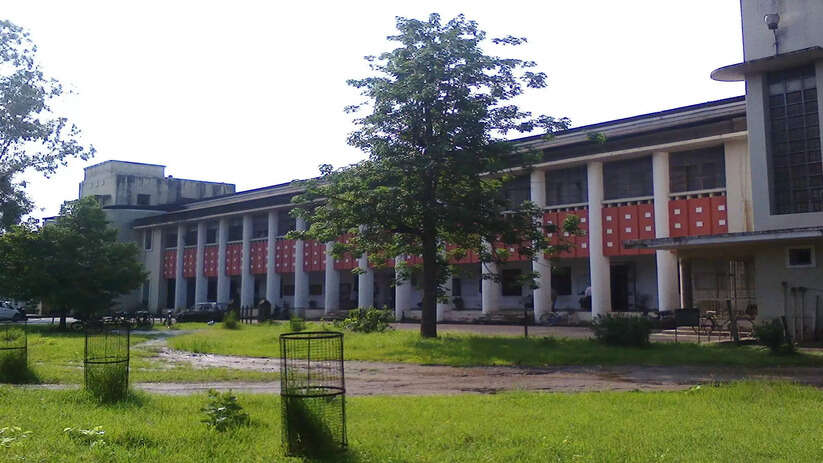
The story of GEC Jabalpur is a haunting elegy for what might have been—a symphony of brilliance cut short, leaving only echoes of unfulfilled promise in India’s technological wilderness. When Late Prof S. P. Chakravarti arrived at its gates in 1947, the institution pulsed with the electric potential of a Bletchley Park of the East. Here, amid the fading colonial architecture, he forged a sanctuary for cryptographic genius and battlefield telecommunication, transforming classrooms into war rooms where oscillators hummed with secrets. His hands—still dusted with chalk from IISc’s lecture halls—now drafted patents like the 1953 "secrecy device," a mechanical poet whispering encrypted sonnets across frequencies. Under his watch, GEC became a temple of innovation: Probably students absorbed tropospheric scatter techniques while engineers dissected jamming-resistant circuits, all breathing the intoxicating air of a future where India would command the world’s communications. The very walls seemed to vibrate with the rhythm of a coming giant.
Yet when Late Prof Chakravarti departed in 1959—called to seed DRDO’s laboratories—the light began to dim. The corridors grew quieter, the oscillators fell silent. Without his relentless vision, GEC’s soul withered. Budgets went toward nuclear ambitions and space dreams; incrementalists replaced pioneers. The tropospheric scatter arrays that once promised satellite-free networks became museum relics in Jabalpur’s neglected places. The "frequency-hopping" prototypes—which might have birthed India’s answer to GPS—gathered dust beside yellowed training manuals. By the 1970s, GEC was merely another engineering college, while Bell Labs crowned itself the telecom deity Chakravarti had envisioned for his institution. The cruel irony? His own creations—thrived in distant DRDO labs, even as GEC’s lecture halls echoed with the ghost of a giant that never stood.
Today, the sadness deepens like monsoon rain. You can stand in GEC’s courtyards and feel the weight of almost: almost a global leader, almost a legend. The archives hold faded blueprints of Chakravarti’s "ultra-wideband filters"—concepts that now underpin 5G worldwide—yet no plaque honors their genesis here. Students walk past classrooms where military radios once crackled with encrypted victories, unaware they tread on hallowed ground. In Hyderabad and Bengaluru, DLRL and LRDE stand as glittering monuments to his legacy, but Jabalpur remains a sepia photograph, frozen in 1958. The world sprints toward 6G and AI-driven networks, while GEC’s greatest contribution of its experiments in 1947-1959 remains nowhere. It’s a tragedy of severed destiny: a giant shackled by apathy, its roar reduced to a whisper in the very nation it sought to elevate. Late Prof Chakravarti planted a forest of innovation, but the tree where it took root was left to rot—a silent, aching testament to the brilliance India forgot to cherish