
Ekadashi Language
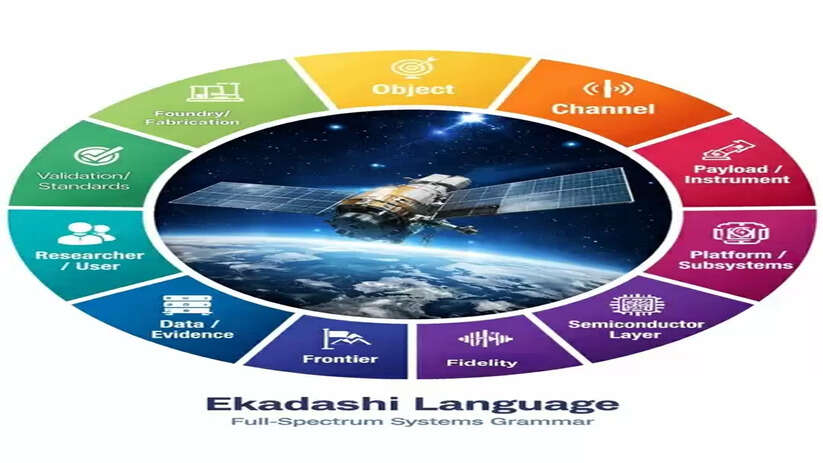
Ekadashi Language is a systems language developed for reading, designing, understanding, evaluating, teaching, and humanizing complex systems, with a particularly strong natural fit for outer space and space technology. It begins from a simple recognition: no serious space system can be fully understood if it is seen only as a machine, only as a mission, only as a payload, or only as a stream of data. A real space system is always several things at once. It is a target of inquiry, a way of knowing, an instrumented body, a survivable platform, an electronic nervous system, a discipline of preserving weak truth, a frontier condition, an evidence-generating structure, a human-use environment, a validation regime, and a fabrication achievement. Ekadashi Language gives these dimensions one coherent grammar.
It is called “Ekadashi” because it is built around eleven irreducible divisions. These divisions are not arbitrary categories. Together they form a complete language for speaking about space systems from first intention to final evidence, and from mission conception to material realization. In this sense, Ekadashi is not merely a classification framework. It is a language of space systems. In outer space, this becomes immediately clear. A telescope is not just optics. A communications satellite is not just a repeater. A station laboratory is not just a pressurized module. A deep-space mission is not just a trajectory. Every one of these exists as an object-bound, channel-dependent, instrument-mediated, platform-supported, electronics-enabled, noise-limited, frontier-facing, evidence-producing, human-serving, standards-governed, and fabrication-grounded system. Ekadashi Language was made to hold all of that at once.
- The first division is the Object. In space technology, the object is what the mission is truly about. It may be a galaxy in the early universe, an exoplanet atmosphere, a debris field, a communication link, a navigation fix, a human body in microgravity, a lunar surface sample, or a final distress call that must not be lost. Space systems begin with an object, whether that object is scientific, operational, strategic, or civilizational. Ekadashi insists that every mission must first answer the question: what, exactly, is being sought, sustained, measured, protected, or transformed?
- The second division is the Channel. Outer space is never known directly. It is known through channels. Light arrives in different wavelength bands. Radio carries communication. Gravitational influence is inferred through motion. Telemetry carries health. Radar returns structure. Timing signals carry navigation. Laser links carry data between spacecraft. Every space system depends on a channel through which an object becomes knowable or reachable. Ekadashi therefore treats channel not as a technical detail, but as a fundamental epistemic condition. A space mission succeeds or fails partly because its channel is appropriate, inappropriate, protected, or misunderstood.
- The third division is the Payload or Instrument. In space technology, the payload is the body through which a channel becomes operational. A camera, a spectrometer, a phased-array system, a synthetic aperture radar, a communications transponder, a regenerative SDR payload, a microgravity experimental rack, a particle detector, or a sample acquisition system-all of these are payload embodiments of different channels. Ekadashi views payloads not merely as devices but as forms of applied knowing. A payload is where physics, intention, and engineering meet.
- The fourth division is the Platform and Subsystems. No payload survives in space on its own. It needs a body. It needs structure, thermal control, power, communications support, onboard computing, guidance, attitude control, propulsion or momentum management, fault protection, deployment logic, harnessing, and survivability. Ekadashi therefore treats the space platform not as a secondary bus around the “real mission,” but as the living body without which no payload can endure vacuum, radiation, eclipse, heat flux, orbital perturbation, or operational duty cycle. In this language, a spacecraft bus is not background. It is the enabling anatomy of mission persistence.
- The fifth division is the Semiconductor and Hidden Electronics Layer. Modern space systems are never only structural and visible. Beneath the spacecraft’s external shape lies a hidden grammar of detectors, converters, clocks, processors, memory, FPGAs, interfaces, PMICs, RF electronics, readout ASICs, and trust-control logic. Ekadashi gives this layer explicit status because in contemporary space technology, the mission is often decided by what the electronic nervous system can or cannot do. A telescope’s sensitivity, a communications satellite’s throughput, a station rack’s control fidelity, a guidance chain’s timing stability, or a probe’s autonomy all depend on this hidden architecture. Space hardware is therefore not only mechanical or orbital; it is semiconductor-conditioned.
- The sixth division is Fidelity, which includes noise discipline, signal protection, and the preservation of weak truth. This division is especially central in space systems because outer space rarely offers strong, convenient, clean signals. A deep infrared observatory must suppress thermal contamination. A radio payload must protect low-level reception from interference and self-noise. A gravitational measurement mission must defend ultra-weak structure against drift and perturbation. A communications satellite must preserve intelligibility through timing stability, filtering, and controlled amplification. Ekadashi insists that no space mission can be understood without asking how truth is defended against corruption. In this sense, fidelity is the moral physics of space engineering.
- The seventh division is the Frontier. Every serious space system points beyond the presently comfortable. Sometimes the frontier is scientific, as in early-universe astronomy, dark sector sensing, or planetary origin studies. Sometimes it is operational, as in resilient public-safety satcom, orbital servicing, global mesh networking, or autonomous cislunar logistics. Sometimes it is civilizational, as in creating a reusable orbital infrastructure or building sovereign fabrication depth for space electronics. Ekadashi includes frontier because any space language that only describes existing capability without honoring the next boundary becomes static too quickly. Space technology lives by edges.
- The eighth division is Data and Evidence. In outer space, data does not automatically become knowledge. Photons, packets, telemetry, event logs, spectra, housekeeping values, orbital state estimates, and error flags must all be calibrated, interpreted, synchronized, archived, modeled, and transformed into evidence. Ekadashi therefore distinguishes sharply between raw signal and credible evidence. This is especially important in space science, mission assurance, anomaly review, and strategic operations. A spacecraft does not merely “produce data.” It produces evidentiary objects whose validity depends on processing history, metadata, uncertainty, provenance, and interpretive discipline.
- The ninth division is the Researcher, User, and Human Interface. Space technology is often discussed as if it were independent of people, but this is false. A mission exists for someone. It serves astronomers, flight surgeons, pilots, sailors, students, emergency responders, field units, mission controllers, commercial subscribers, operators, analysts, or a scientific community. Even when the spacecraft is uncrewed, the system is still human-situated. Ekadashi restores that human location. It asks not only what the spacecraft does, but for whom it matters, who interprets it, who depends on it, who trusts it, and who suffers when it fails.
- The tenth division is Validation and Standards. Space technology cannot rest on elegance or ambition alone. It must be tested, verified, constrained, benchmarked, reviewed, qualified, and made repeatable. A deployable antenna must work in reality, not only in the design note. A payload chain must survive vibration, vacuum, thermal cycling, and operational modes. A flight computer must behave under upset conditions. A calibration pipeline must justify its claims. Ekadashi treats validation not as a bureaucratic afterthought but as the discipline that makes space systems worthy of trust. In outer space, where repair is rare and failure is costly, standards are not ornamental-they are existential.
- The eleventh division is Foundry and Fabrication. This division reminds us that no space mission appears from abstraction. Every spacecraft rests on prior making: detectors, semiconductors, structures, coatings, composites, harnesses, optics, reaction wheels, batteries, solar arrays, thermal links, passives, connectors, deployment hardware, and assembly processes. A telescope reflects a civilization’s polishing depth. A radar spacecraft reflects its electronics ecosystem. A megaconstellation reflects its manufacturing cadence. A cryogenic payload reflects its material mastery. Ekadashi calls this the foundry layer because space systems are always downstream of fabrication civilization. Space is never only a place of discovery. It is also a test of what a civilization can reliably make.
What makes Ekadashi Language distinctive is that it is not only descriptive. It is bidirectional. It can move from concept to architecture, and it can move from architecture back to meaning. It can help generate a new spacecraft from first principles, but it can also read an existing spacecraft-such as a communications satellite, a space station laboratory, a large observatory, or a megaconstellation node-and decode its object, channel, payload, platform, electronics, fidelity logic, frontier ambition, evidentiary structure, human use, validation regime, and fabrication basis. This gives Ekadashi unusual flexibility. It is both a design grammar and a reading grammar. For outer space and space technology, this is especially valuable. It means that the same language can be used to interpret JWST, a radio relay satellite, an ISS lab rack, a high-capacity GEO satcom platform, a LEO broadband constellation, a deep-space science mission, or a future orbital servicing vehicle. The surface details differ, but the Ekadashi grammar remains stable. That is why it functions as a language rather than only as a checklist.
Ekadashi also has a pedagogical strength. Space technology is often taught in fragmented silos: payloads in one course, structures in another, signals in another, chips elsewhere, and validation somewhere near the end. Ekadashi reassembles the whole. It allows a student to see that a space system is not merely a stack of disciplines, but a coherent organism. This makes it especially suitable for postgraduate education in aerospace, systems engineering, mission design, communications, instrumentation, and space policy. It can also scale downward into literacy form, turning the eleven divisions into foundational habits of thinking about complex systems. At the same time, Ekadashi is not hostile to rigor. It does not seek to replace formal systems engineering languages. SysML may still be stronger as a formal industrial modeling notation, and OPM may still be stronger as a unified object-process methodology. But Ekadashi extends beyond these by integrating not only architecture and behavior, but also evidence, human use, pedagogy, fabrication, and meaning. It asks not only how a system is structured and how it behaves, but what it is for, how it becomes credible, who it serves, and what prior civilization had to exist for it to be built at all.
This is why Ekadashi can also cross into narrative without ceasing to be a space technology language. A communications satellite can be described as a bus, an RF chain, and a payload-and it can also be described as the system that preserves the final intelligibility of a dying officer’s last call. A telescope can be described as an optical and cryogenic observatory-and it can also be described as a civilization’s disciplined attempt to listen to very old light. A foundry can be described as a supply chain-and also as patience condensed into orbital consequence. Ekadashi allows such translation because it already carries human meaning within technical structure. In this sense, Ekadashi Language is best understood as a full-spectrum language of space systems. It reads space systems. It helps build them. It explains them. It teaches them. It judges them. It humanizes them. It allows outer space to be spoken not only as engineering, but as knowledge, service, evidence, endurance, and civilization.